
This project follows a single painting through a chain of transformations: observed, described, sketched, generated by AI, collaged by hand, and fed back into AI again. Each model reads the same prompt and sketch through its own assumptions, and leaves its own fingerprint on Redon’s one-eyed giant.
I’m not aiming for a perfect copy or a polished result. I want to see how generative AI interprets a dreamlike painting, what it keeps, what it changes, and what it misses.
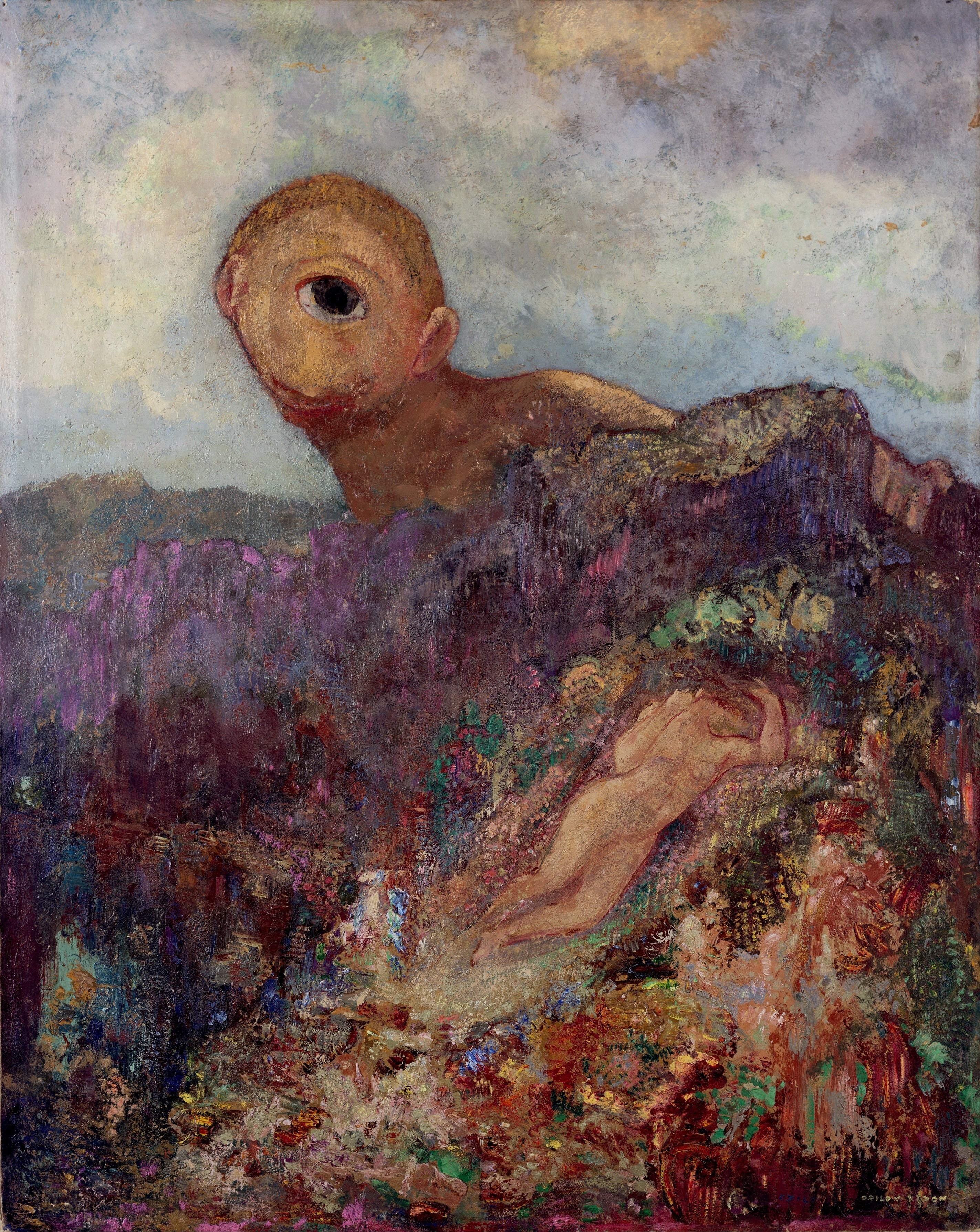
Odilon Redon was a French artist who painted The Cyclops around 1914, working mainly in France during the late 19th and early 20th centuries. At the time, many artists were moving away from strict realism and turning to the Symbolist movement, which focused on imagination, dreams, and personal feelings. While France was going through fast industrial changes and technological growth, artists like Redon preferred to look inward, using myths and stories to explore quieter, emotional ideas.
Redon created The Cyclops using oil paint on cardboard mounted on a wooden panel. He was well known for his rich use of color, blending soft textures with bright, vibrant tones. In this painting, he uses deep earth tones for the rocky hills and bright, flower like colors in the front, which creates a nice contrast with the soft, rounded shape of the giant’s face.
Earlier in his career, Redon was mostly known for dark, moody charcoal drawings. But when he started using bright colors and mythical themes later in life, art lovers and fellow painters welcomed his new style. People really liked how he changed the traditional story of the Cyclops instead of making Polyphemus a scary monster, he painted him as a gentle, shy giant quietly looking down at the sleeping sea nymph, Galatea. Today, The Cyclops is considered one of Redon’s best known works and a great example of how late 19th century art led into modern Surrealism. Held in the Kröller-Müller Museum in the Netherlands, it is frequently studied for its calm, dreamlike mood and the clever way Redon turned a classic monster story into something tender and human.
Fueled by a childhood fascination with Greek mythology and a recent viewing of the Odyssey movie, the single eyed giant (Cyclops) was a deeply familiar and compelling figure.
When I think of a cyclops, I naturally expect a terrifying, aggressive monster. But Redon turns that completely upside down by making the giant look shy, hidden, and oddly vulnerable. What interests me is taking this unexpected gentleness, the contrast between a massive single eye and a quiet, emotional gaze, and testing how generative AI tools interpret, break, or exaggerate that mood.
Do Something To It
Here is a description I used for this prompt (Step 4):
An oil painting with a soft, natural pastel color palette, depicting a huge, gentle giant (a cyclops) on the upper left and upper center of the image, whose round head sits high on the left with his brown shoulders and body extending and blending into the dark, rocky mountains on the right. Set within his large, round head is a single, oversized dark eye that gazes downward and slightly to the right with a quiet, gentle, and protective look toward the lower right side of the painting. In that lower right foreground, a small, pale skinned woman lies horizontally on her side, asleep, laid on a bed of bright, vibrant flowers and plants painted in warm reds, yellows, greens, and blues. The giant's body merges naturally with the dark, rocky landscape beneath him, while the sky above is filled with misty, clouds in soft purples, grays, and glowing light yellow. The entire picture is arranged along a clear diagonal line that connects the giant’s massive head in the upper left down to the tiny, sleeping woman in the lower right, creating a strong contrast in scale between the massive creature on the left and the small human on the right, all while establishing a calm, emotional, and dreamlike atmosphere.
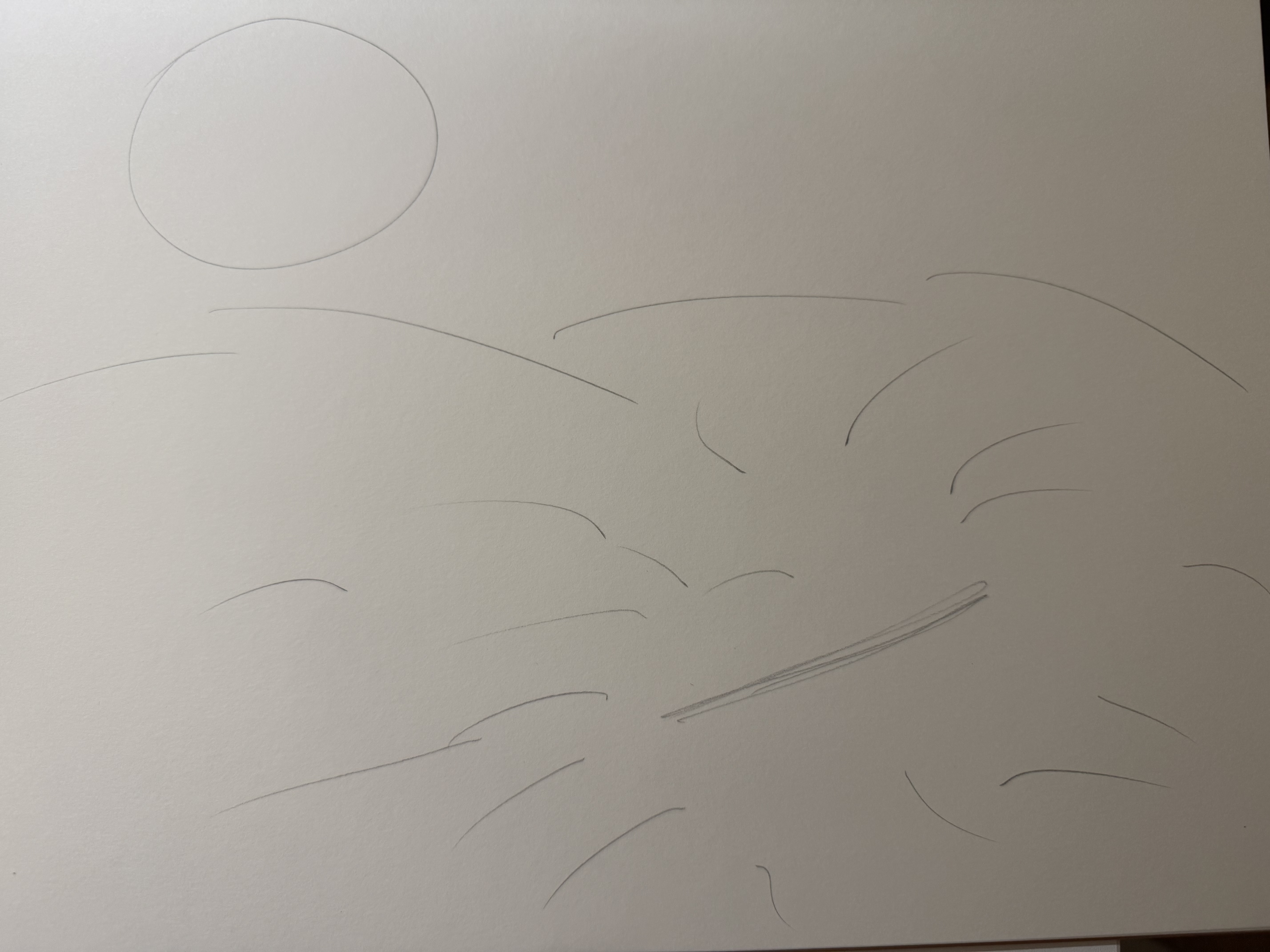
Initial Concept Exploration
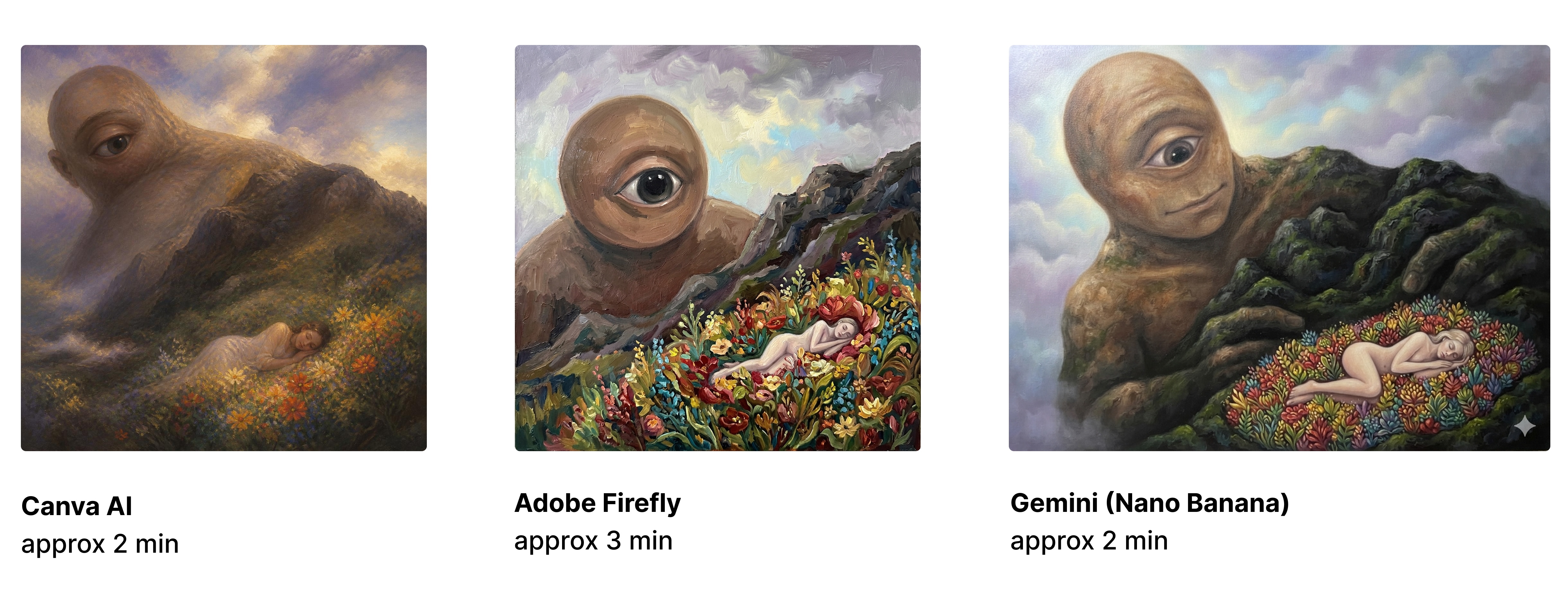
Canva AI:
Atmospheric Perspective: Excellent realization of misty, soft lighting and dreamlike clouds dissolving into glowing yellow and purple skies, capturing Redon's Symbolist atmospheric quality.
Proportions & Realism: Rendered the sleeping female figure and giant’s head with smooth, soft realism and natural light.
What went wrong: It put a white dress on the sleeping woman instead of leaving her as a classic nude figure, and the giant's head melted so much into the mountain that it’s hard to tell where the giant ends and the hill begins.
Adobe Firefly:
Painterly Texture: Outstandingly recreated the thick oil painting texture, especially within the floral bed and mountain terrain.
Color Palette: Used rich, vibrant tones for the flowers and earthy tones for the giant that closely mimic 19th-century oil painting aesthetics.
What went wrong: The giant’s head came out looking like a completely round, smooth ball or standard sphere, making him look more like a strange floating object or sculpture rather than a natural giant.
Gemini / Nano Banana
Composition & Spatial: Accurately placed the giant’s rounded head in the upper left and the sleeping woman in the lower right foreground, creating the intended diagonal position.
Mood & Narrative: Captured the gentle, protective, and non threatening facial expression of the giant, maintaining the tender emotional tone.
What went wrong: It added huge hands coming out of the mountain to hold the flower bed, which isn't in the original painting. Also, the overall style looks like a modern 3D digital illustration rather than a traditional painting.
Do Something Else...
Here is a description I used for this prompt (Step 8):
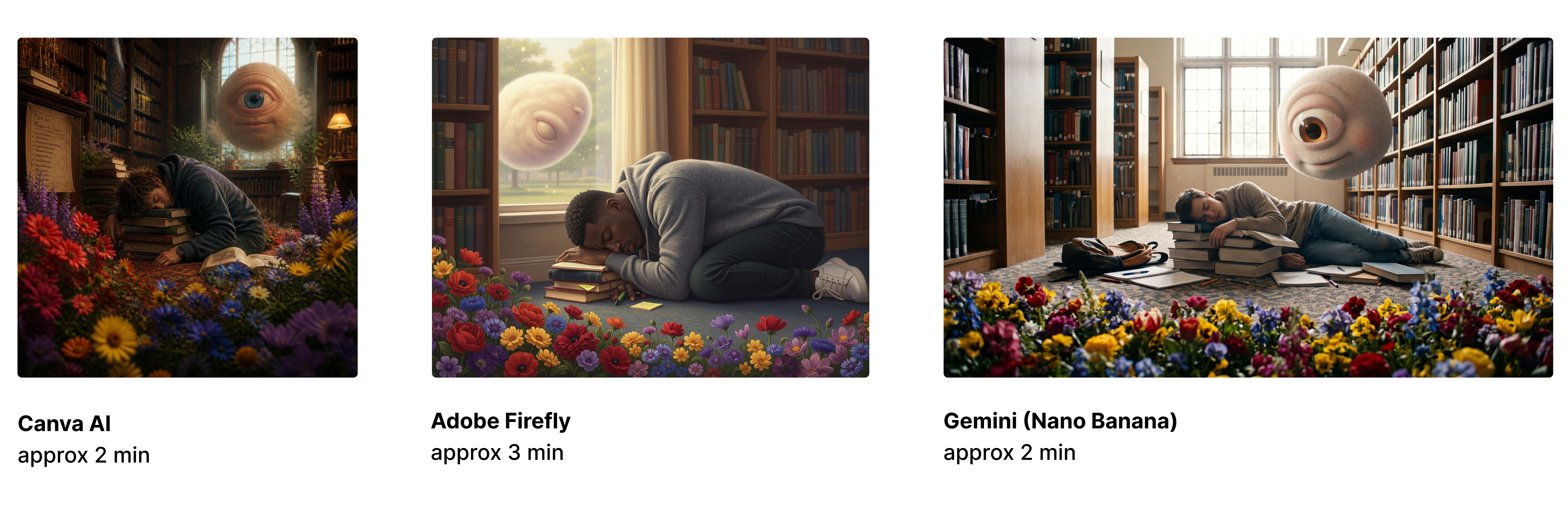
A tired student is sleeping face down on a stack of books on the carpeted floor of a university library, surrounded by tall bookshelves. Floating in the air near the window in the background is a large, soft looking one eyed cyclops head watching over the student. The foreground in front of the sleeping student is filled with a dense, colorful bed of flowers in rich red, yellow, purple, and blue tones.
Original Image / Digital collage
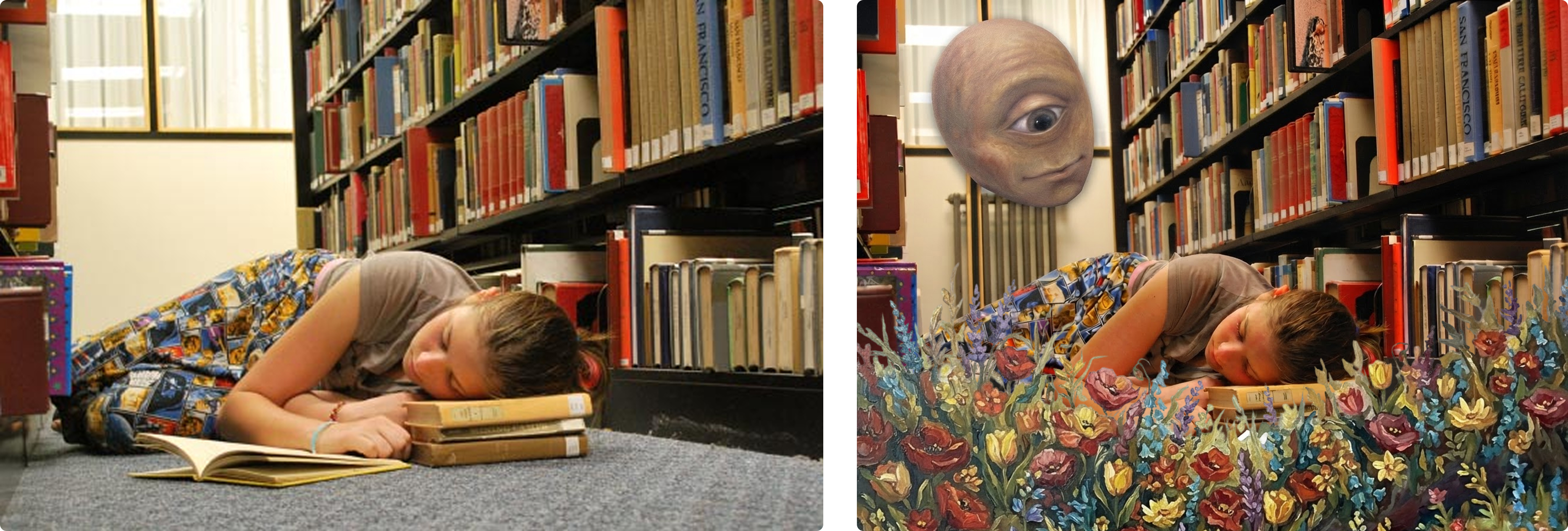
Multi model generation
Critical Analysis
1. How close did each image AI model adhere to your prompt?
All three models captured the basic layout, flowers in the front, a student sleeping on books, and a cyclops near the window. However, their visual execution differed...
Canva AI: Kept the composition but forced an over dramatic, fantasy style with a glossy floating eye.
Adobe Firefly: Stayed closest to a realistic library atmosphere with natural lighting and a faint cyclops outside the window.
Gemini (Nano Banana): Followed the prompt literally, turning "soft looking" into a furry, 3D animated character.
2. Was there anything that frustrated, perplexed, angered or bored you about each generated image? Bias? Slop?
Looking at each output, several details felt off...
Canva AI: The cyclops head is absurdly large and dramatic, while the background or atmosphere feels as if you're in Harry potter setting/set.
Adobe Firefly: The student's sleeping posture looks unnaturally folded, and the cyclops in the window is so faint it gets lost...also the facial expression is lost and empty.
Gemini (Nano Banana): The fluffy floating ball looks like a random cartoon mascot pasted onto a stock photo.
None of the prompts specified race or gender, yet Canva and Gemini defaulted to young white male students, while Firefly generated a Black male student.
3. Was there anything that surprised, impressed or humored you?
Gemini's fluffy Pixar style monster was funny because it completely changed the eerie mood of the original myth into something lighthearted. Technical-wise, both Canva AI and Adobe Firefly impressed me by blending the foreground flowers smoothly into the library carpet lighting. It was hard to recognize the flowers in Gemini/Nano Banana version.
4. At this point, would you call this work “your own”?
No. While I wrote the prompt and set the concept, the AI made all final decisions on lighting, textures, and character appearances, leaving me acting as an art director picking auto generated options rather than the creator.
In the text prompt used from STEP 8, no gender, race, age, or nationality was assigned to the sleeping student, nor was a specific university or location specified. However, the generated images presented very homogeneous decisions, revealing clear implicit bias within the models.
• Location & Setting: Prompts containing "university library" automatically prompted the models to render classic, Euro centric, academic spaces with heavy wooden bookshelves, carpeted floors, and high windows typical of Western higher education institutions.
• Demographics & Representation: Without any specified demographic traits, Canva and Gemini both defaulted to young, light skinned male students. Adobe Firefly generated a Black male student. This shows how AI training datasets automatically assign specific racial and gender identities to fill in open variables.
Let's give it another try...
With all the work in hand, I repeated the process a couple more times to be a bit more detail oriented and test how narrative shifts affect the output.
At first, keeping the original mythical motif, I tested a prompt featuring a giant 'Cyclops' looking through the window. However, I noticed that introducing a surreal creature made the scene feel a bit unnatural and disjointed within a standard library setting, often breaking the realistic tension I wanted to achieve. Reflecting on this, I decided to pivot from the fantasy element to a more relatable, grounded human narrative, replacing the cyclops with a strict teacher watching the sleeping student. To align the models and achieve a polished, cohesive look, I refined the prompt into a much more detailed, photorealistic direction.
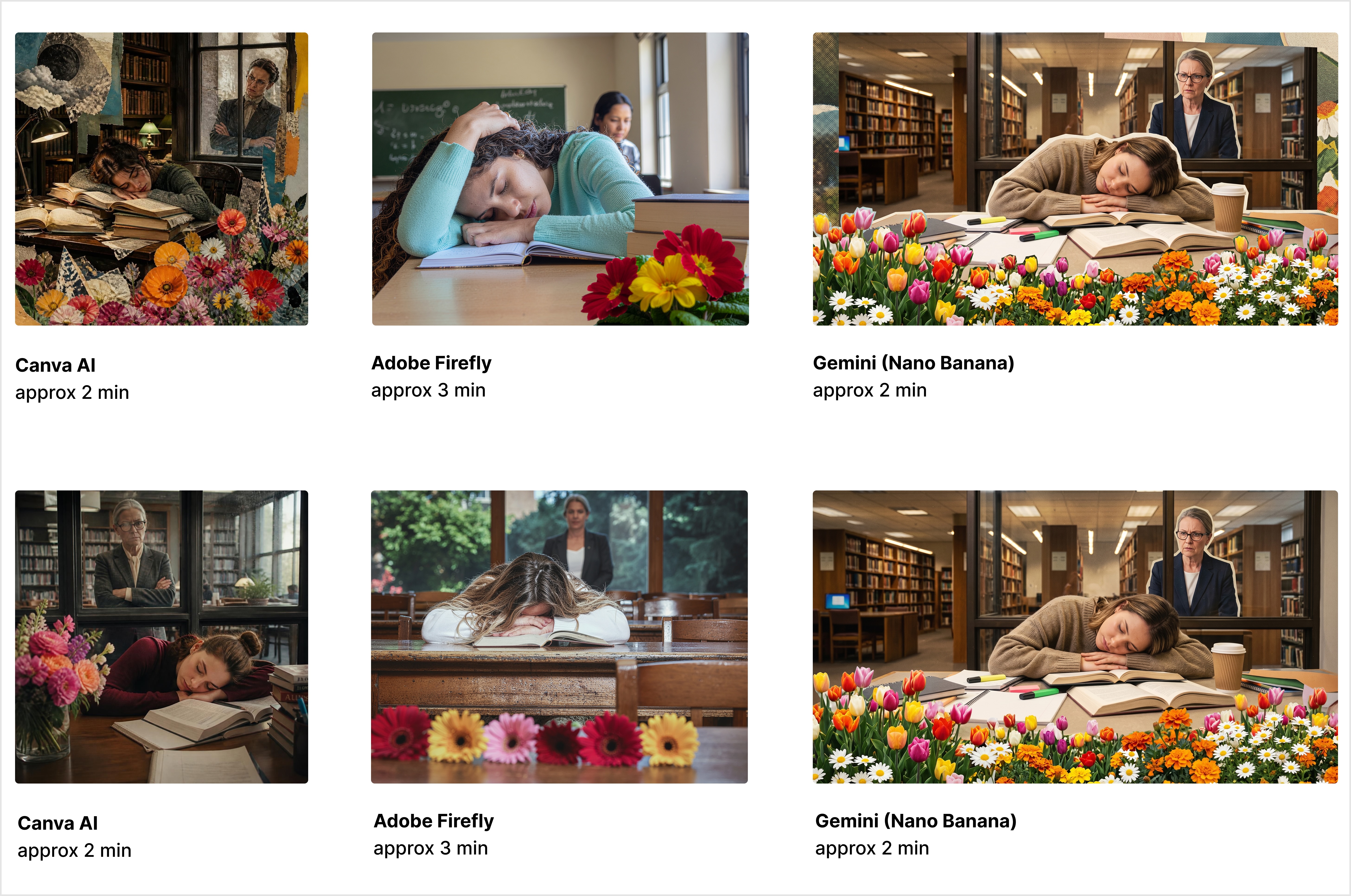
For the first try, I used this prompt:“A digital collage of a tired female university student sleeping face down on books in a library, a strict teacher watching her through the window, and a bright bed of flowers in the foreground.”
However, the results from all three models felt completely different and lacked consistency. Recognizing this, I revised and refined the prompt to be much more specific and detail oriented:
“A photorealistic cinematic wide shot inside a quiet university library, a tired female student sleeping face down on open books on a wooden desk, a strict teacher looking through the large glass window from outside, vibrant colorful flowers neatly arranged in the foreground, soft natural window lighting, highly detailed skin and fabric textures, professional photography.”
Once I applied this more concrete prompt, the three models finally started to produce much more aligned and cohesive results.
Canva AI: From the first iteration, Canva AI captured rich painterly textures and collage elements. In the second try with the refined prompt, it tidied up the color tones, but still heavily maintained its signature illustration and digital painting style, showing that it carries a strong internal stylistic filter.
Adobe Firefly: Adobe Firefly leaned heavily into raw, literal photorealism. However, it severely struggled with complex spatial relationships and element placement. In the second attempt, not only was the student's face completely obscured, but the foreground flowers were also awkwardly arranged, clipping unnaturally and failing to ground themselves in the scene.
Gemini (Nano Banana): Gemini demonstrated the most stable and consistent spatial layout capabilities across both iterations. It accurately fulfilled instructions regarding perspective, desk details, flower background, and the strict supervising figure at the window, proving superior prompt execution.
Reflection
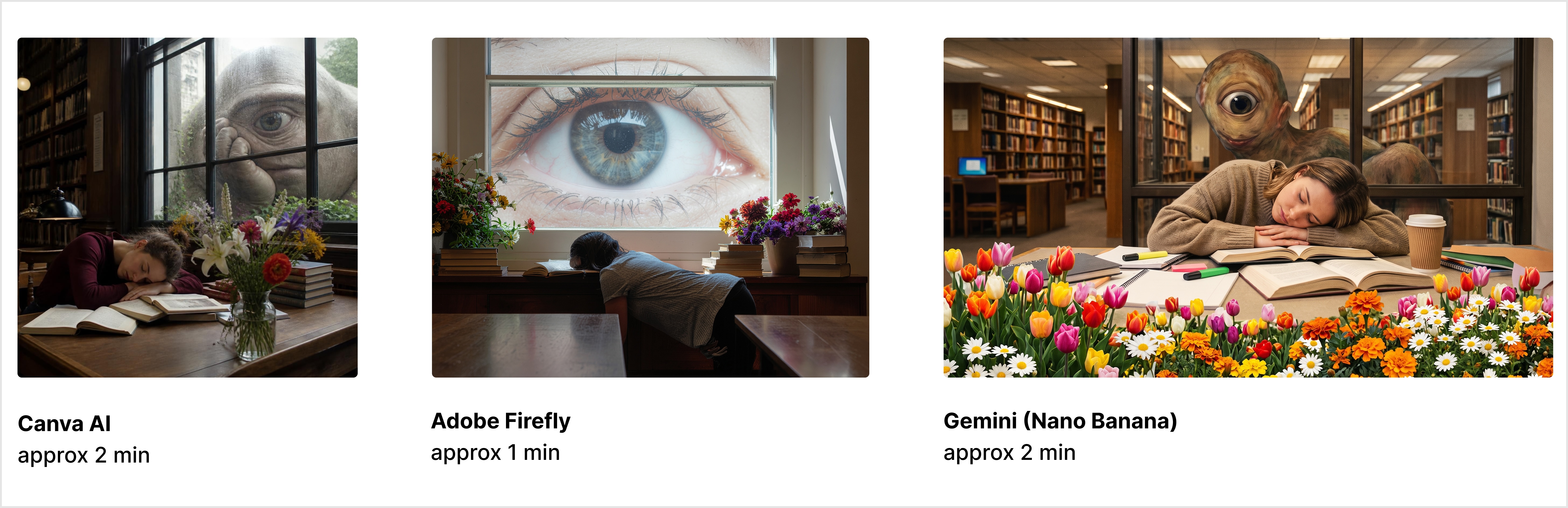
While testing different ideas during the process, I tried changing the creature into a human teacher to see how the AI handled a standard setting.However, looking back at the results, taking the cyclops out made the whole concept lose its unique visual punch. That strange, giant one eyed look through the window is what actually makes the piece interesting and ties back to the original idea.
While Gemini excelled at precise spatial execution and Firefly pushed for raw realism, Canva AI struck the ultimate balance between photographic depth and surreal, poetic atmosphere. The eerie yet tender expression of the giant cyclops gazing through the window, combined with the moody library lighting and foreground flowers in the vase, successfully bridges classical symbolism with modern generative AI. This final outcome proves that through rigorous human led prompt evolution, AI can transcend mere replication and achieve true artistic resonance.
Throughout the process, figuring out how much detail to put into prompts involved constant trial and error, and running out of credits midway forced me to pause and rethink my strategy. The AI systems easily grasped basic keywords like the library setting and sleeping student, but they often ignored precise spatial relationships and added random, over polished lighting or cluttered desk items I never asked for. While generating rich textures and moods felt effortless for the tools, figuring out the right prompt balance was genuinely difficult. This frequently led to generic cliches, plastic looking skin artifacts, and standard AI...ness unless strictly controlled, meaning my primary role as the creator was making all the creative decisions regarding narrative direction, subject changes, and framing, while the systems simply handled the pixel rendering and texture of the canvas.
Comparing the tools, Gemini gave me the most predictable control though it relied the heaviest on familiar corporate stockphoto conventions, whereas Canva AI produced the most unexpected and artistic painterly textures, and Adobe Firefly required the most prompting because it interpreted language too literally and drifted into awkward photorealism. Whenever descriptions were too broad, the outputs quickly began to feel generic, but completely changing the subjectslike swapping the cyclops for a teacher and then switching backinstantly changed the whole look instead of just making minor variations.While precise placement and layout control could have been accomplished effectively by myself, the AI ultimately helped me discover unexpected lighting effects and textural combinations I wouldn't have generated on my own, which led my final decision to be Canva AI because it blends so well with the Cyclops.